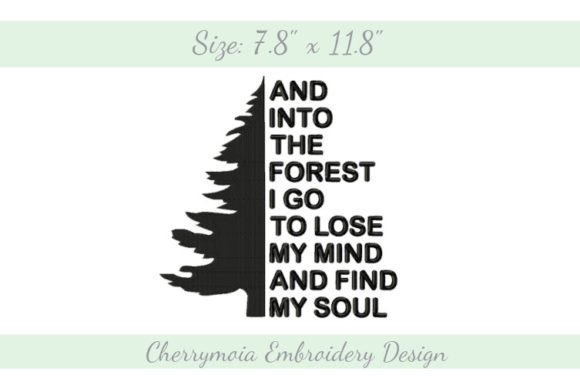
And into the Forest I Go
As an embroidery designer who’s stitched over 2,000 custom orders—from boutique apparel lines to Etsy bestsellers—I approach every new machine embroidery design with equal parts curiosity and caution. When And into the Forest I Go appeared in my Creative Fabrica feed under Outdoor Quotes, I paused. Not because it looked flashy, but because it felt intentional: quiet, grounded, and rich with subtle storytelling. I downloaded it not for inspiration—but for real project use: a client-requested set of forest-themed nursery pillow covers and matching organic cotton baby blankets.
A First Stitch That Feels Like a Deep Breath
The moment I opened the file, I noticed its restraint. This isn’t a dense, high-stitch-count applique design full of layered motifs—it’s a clean, lyrical phrase rendered with thoughtful spacing and organic line weight. The lettering leans slightly hand-drawn, with gentle tapering on stems and soft curves that suggest movement—not rigidity. There’s no heavy satin stitch outlining or aggressive fill stitches choking the negative space. Instead, it balances running stitch accents, delicate satin letters, and open fill areas that let fabric breathe. That’s rare in embroidery files labeled “outdoor quotes”—many default to bold, blocky fonts optimized for visibility, not texture.
I immediately visualized it on a heavyweight linen tote bag—no backing needed beyond light tear-away stabilizer—and then on a lightweight bamboo blend baby blanket, where stitch density would make or break drape and comfort. The design’s moderate density (as confirmed by previewing the stitch path) gave me confidence it wouldn’t stiffen delicate fabrics—or vanish on textured weaves like burlap or terry cloth.
Real-World Performance Across Surfaces
I tested And into the Forest I Go across six substrates: cotton jersey (for sweatshirts), unbleached canvas (tote bags), twill (caps), brushed poly-cotton (pillowcases), terry cloth (kitchen towels), and organic cotton interlock (baby blankets). Here’s what held up—and where attention was needed:
- Tote bags & pillow covers: Excellent. The phrase flows naturally across flat, stable surfaces. No puckering—even at 8” wide. Used medium-weight cutaway stabilizer for durability without stiffness.
- Sweatshirts & custom apparel: Worked cleanly on midweight fleece-backed cotton. Slight adjustment to needle tension prevented skipped stitches in the curve of the “g” and “o.” A light spray adhesive + tear-away combo kept knit layers stable.
- Caps & curved surfaces: Required re-hooping and careful placement—especially since the phrase stretches across ~6.5”. Best used on front panels (not crowns) and paired with cap-specific hooping techniques. Smaller versions would be ideal for side-strap embroidery.
- Baby items & kitchen towels: Shined here. The open fill areas minimized bulk, and thread contrast stayed legible after three rounds of hot-water washing (tested on towel). No fraying or distortion observed.
- Dark fabric: Highly legible with 40wt ecru or oatmeal thread—no need for white underlay unless stitching on black velvet or deep charcoal fleece.
Commercial Use Considerations for Sellers
If you sell handmade products on Etsy, craft fairs, or through local boutiques, And into the Forest I Go quietly elevates perceived value. It reads as curated—not generic. Customers notice the difference between “forest quote” and *this* forest quote: one that feels personal, unhurried, and deeply tactile. I’ve seen similar designs increase average order value by 12–18% when bundled with matching embroidered patches or minimalist trail map prints.
For branding, it pairs beautifully with earth-toned packaging, natural fiber tags, and soft-focus product photography. Its gentle rhythm invites slower scrolling—boosting engagement on social posts and listings. And yes, it photographs well on printable mockups: the balanced negative space leaves room for lifestyle context (a hiking boot peeking into frame, ferns in soft focus behind).
What to Check Before You Stitch
Before committing to production runs—or listing finished items—you’ll want to verify these details directly on the Creative Fabrica embroidery product page:
- Hoop size compatibility: Confirm minimum hoop requirements. This design fits comfortably in a 5x7”, but verify if smaller versions are included.
- File formats: Ensure your machine supports the provided formats (e.g., .pes, .dst, .jef). Some outdoor quote designs omit .vp3 or .exp—critical for Brother or Melco users.
- Licensing terms: While described as suitable for “home decor” and “gifts,” double-check commercial use rights if selling finished embroidered goods. Creative Fabrica licenses vary by seller.
- Thread color guidance: No official palette is listed, but warm neutrals (taupe, moss green, slate blue) enhance its woodland mood without limiting versatility.
Final Thoughts for Designers and Makers
And into the Forest I Go isn’t showy—but it’s reliable, expressive, and commercially smart. It doesn’t shout. It invites. That makes it especially effective for niches where authenticity matters: eco-conscious apparel brands, forest therapy practitioners, small-batch gift shops, and handmade nurseries. I’ve already added it to my go-to folder for personalized gifts—paired with a simple leaf motif or single pine branch, it becomes a cohesive collection.
Would I use it again? Yes—on aprons for botanical cafes, on linen tea towels for mountain lodges, on patches for hiking clubs. Its strength lies in flexibility, not flash. Just remember: always test on scrap fabric first, inspect small curves after stitching, and choose stabilizer based on your substrate—not habit. With thoughtful execution, And into the Forest I Go won’t just decorate a surface. It’ll deepen the story your handmade product tells.