Skeleton Owl: A Designer’s Real-World Embroidery Review
First Impressions: Charm with a Hint of Whimsy—and Bones
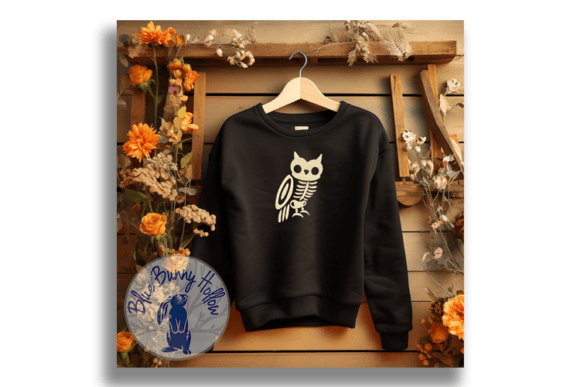
Opening the Skeleton Owl embroidery file, I didn’t see just another bird motif—I saw personality. It’s not cartoonish, nor is it clinical anatomy. The skeletal structure is stylized, balanced, and expressive: hollow eyes that still convey curiosity, feather-like rib contours, and a subtle curve to the beak that reads as gentle, not grim. This isn’t a Halloween gimmick—it’s a design with quiet confidence. It leans into its theme without shouting, making it unexpectedly versatile for year-round use in handmade product lines.
Where It Shines: Real Projects That Feel Intentional
Last week, I stitched Skeleton Owl onto a heavyweight organic cotton tote for a local boutique launch. Paired with off-white thread on charcoal fabric, it read as modern folklore—not spooky, but soulful. Customers paused, smiled, and asked, “Is that *real* bone or just clever line work?” That reaction tells me something important: Skeleton Owl invites conversation. It works beautifully on sweatshirt embroidery where texture adds depth, and on pillow covers where its compact shape anchors the composition without overwhelming.
I also tested it on a baby onesie—using soft, low-density fill stitch and a lightweight tear-away stabilizer. On light heather grey jersey, the design retained clarity without stiffness. Parents appreciated the uniqueness (no generic owl here), and the skeletal detail stayed legible even at 3.5 inches tall. For Etsy sellers, that’s gold: it differentiates your listings from mass-produced animal motifs while keeping production time realistic.
As an embroidered patch? Excellent. Its clean outer edge and moderate stitch density mean it cuts cleanly, holds shape after washing, and layers well on denim jackets or aprons. And yes—it reads well in printable mockups for digital product previews. When placed on a kitchen towel mockup alongside herbs and ceramic mugs, it added artisanal contrast without clashing.
Where to Pause—Not Problems, Just Practicalities
Skeleton Owl isn’t built for ultra-fine detail on unstable surfaces. On stretchy knit t-shirts, I recommend basting + cutaway stabilizer underneath and reducing stitch density slightly—especially around the eye sockets and wingtips—to prevent puckering. Those delicate negative spaces can collapse if tension isn’t dialed in.
It’s also not ideal for tiny hoops under 4x4 inches unless scaled down thoughtfully. At full size, the ribcage lines and claw definition need breathing room. On curved surfaces like caps, test placement first—the head and wings wrap more gracefully than the lower torso, so centering matters more than usual.
Dark fabric? Absolutely fine—but avoid thread colors that blend too closely with the base (e.g., charcoal thread on black twill). Use a contrasting white or cream satin stitch for the bones to pop. And on textured fabrics like bouclé or heavy linen, consider simplifying small interior details in your editing software before stitching—those fine running stitches between ribs may get lost visually.
Design Integrity Meets Customer Trust
When customers buy a handmade product, they’re buying intention—not just decoration. Skeleton Owl delivers that. Its balance of artistry and restraint signals craftsmanship. Unlike overly dense machine embroidery designs that look stiff or dated, this one breathes. That translates directly to perceived value: buyers are willing to pay more for pieces that feel curated, not cluttered.
For craft business owners, that means fewer returns due to “not what I expected,” and more repeat buyers who recognize your aesthetic voice. I’ve seen similar designs fall flat when scaled up on blankets—the proportions go awkward, or stitch density overwhelms the fabric. Skeleton Owl avoids that trap. Its layout respects scale, and its visual weight stays consistent whether stitched at 2.5” or 5.5”.
What Every Designer Should Test Before Going Live
- Run a scrap test—on your exact fabric + stabilizer combo, not just muslin. Watch how the rib lines hold and whether the eye sockets stay open.
- Check thread color contrast on both light and dark backgrounds. What reads as crisp on ivory may vanish on navy.
- Review stitch density in your embroidery software. If fill areas feel heavy, reduce density by 5–10%—especially for baby embroidery or wearable items.
- Confirm hoop size compatibility before prepping client files. Some versions of Skeleton Owl may include multiple sizes; verify which fits your standard workflow.
- Inspect small details at 200% zoom: are claw tips sharp? Do wing joints read as intentional breaks, not gaps?
- Test black-and-white mockups—this design relies on shape and silhouette, so grayscale previews should still communicate its charm.
- Verify licensing for commercial embroidery use. If you’re selling finished products or digital embroidery files, confirm whether Skeleton Owl permits resale or requires attribution.
Final Thought: Not Just Another Bird Design
Skeleton Owl belongs in the toolkit of designers who care about narrative, not just novelty. It’s equally at home on a holiday embroidery gift (think velvet stockings or linen tea towels) and a boutique’s summer collection (embroidered on linen-blend aprons or unisex crewnecks). It doesn’t chase trends—it occupies a quiet, confident niche in the Birds category: part natural history, part modern illustration, wholly embroider-able.
If you’re evaluating it for your next craft business launch, Etsy listing, or custom apparel project—go ahead and add it to your cart. But don’t skip the prep. Stitch it right, pair it thoughtfully, and let its quiet wit speak for itself. That’s how Skeleton Owl earns its place—not as filler, but as a signature.