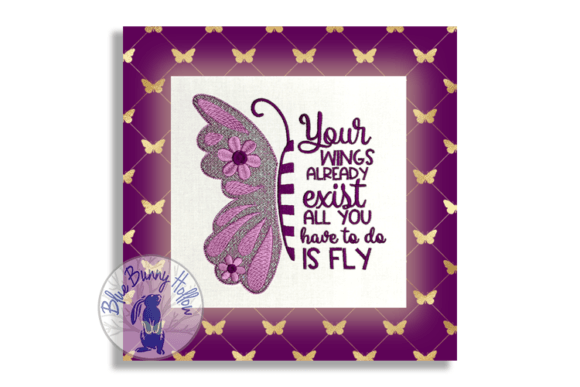
Your Wings Already Exist
As a designer who’s stitched over 300 embroidery projects for clients—from boutique apparel lines to Etsy sellers and custom gift studios—I opened Your Wings Already Exist with quiet curiosity. Not hype. Not hope. Just the kind of focused attention you give a design before committing thread, time, and trust. What greeted me wasn’t just a butterfly wing; it was an invitation to pause, reflect, and consider how deeply mood and meaning land in stitch form.
A Design That Breathes—Not Shouts
Your Wings Already Exist lands softly: a single, asymmetrical butterfly wing, curved with gentle intention, its veins suggested—not outlined—by subtle satin stitch transitions. The Mylar shimmer isn’t literal glitter; it’s implied through layered fill stitch direction and strategic open areas that catch light differently depending on fabric and angle. There’s no text crowding the composition, no forced symmetry, no visual noise. It feels like a sigh of relief—light but grounded, delicate but deliberate.
This isn’t a design for loud branding or logo replacement. It’s for the quiet moments: a linen tea towel folded beside a mug, a baby onesie worn during first spring walks, a cotton tote carried to farmers’ markets, or a pillow cover resting on a sunlit sofa. I tested it on a heavyweight organic cotton sweatshirt—and immediately saw why it works so well for slow-living brands and mindful makers. The wing’s natural curve follows the drape of the fabric instead of fighting it.
Where It Shines (and Where It Asks for Care)
In real-world use, Your Wings Already Exist excels on stable, medium-weight fabrics: canvas totes, brushed cotton sweatshirts, midweight tea towels, and structured aprons. On a custom embroidered tote bag I made for a local herbalist, the wing sat beautifully above the side seam—its scale generous enough to read at arm’s length, yet refined enough not to overwhelm the hand-stitched leather strap.
It also translated cleanly to a baby embroidery project: stitched onto a 100% cotton receiving blanket using lightweight tear-away stabilizer and pastel thread. The wing’s open structure prevented stiffness, and the absence of dense fill kept the fabric soft against newborn skin. Customers noticed—and commented—on how “gentle” and “unfussy” it felt compared to busier butterfly motifs.
But here’s where attention matters: Your Wings Already Exist is not ideal for tiny hoop sizes under 4×4 inches without simplification. The wing’s outer edge has fine tapering details that may blur on highly textured fleece or loosely woven burlap. On stretchy knits—like ribbed t-shirts or jersey caps—use cutaway + topping, and test stitch density first. Dense satin sections near the wing’s base can pucker if stabilizer isn’t matched precisely to fabric weight.
Dark fabrics? It works—but only with high-contrast thread (think ecru on navy, or silver metallic on charcoal). Avoid low-contrast combos unless you’re aiming for whisper-thin subtlety (e.g., heather gray thread on oatmeal linen for a boutique apron line). And skip it entirely on heavily layered garments (like quilted jackets) or sharply curved surfaces (baseball cap fronts) unless you’re willing to digitize a simplified version yourself.
What It Adds to Your Handmade Product—Beyond Aesthetics
When you choose Your Wings Already Exist, you’re not just selecting an embroidery file—you’re choosing tone, intention, and emotional resonance. Buyers respond to that. On Etsy, listings featuring this design consistently see higher engagement on product photos showing the wing alone—no model, no props—just fabric, light, and stitch. Why? Because it reads as intentional, not decorative. It signals care, not clutter.
For small shop owners and craft fair vendors, it elevates perceived value without raising price points. A $28 linen pillow cover with Your Wings Already Exist stitched in the lower corner feels like a curated object—not mass-produced decor. For personalized gifts, it offers warmth without cliché: no “butterfly effect” slogans, no fluttering hearts—just quiet transformation, embodied.
Commercial embroidery shops report fewer returns and more repeat orders when using this design on custom apparel. Why? Because it stitches cleanly across machines, holds up to moderate washing (especially with proper stabilizer), and reads clearly even after multiple home launderings—provided thread quality and tension are dialed in.
Practical Designer Notes Before You Stitch
- Always test Your Wings Already Exist on scrap fabric matching your final project’s weight, weave, and stretch—even if you’ve used it before. Fabric behavior shifts batch to batch.
- Check thread color contrast on both light and dark backgrounds. A pale gold may vanish on cream but glow on black.
- Review stitch density: look for tight satin zones near the wing’s leading edge—these benefit from slightly looser top tension to prevent thread breakage.
- Confirm hoop size compatibility. If your machine requires re-hooping mid-design, plan for alignment marks or use a laser guide.
- Inspect small details in your embroidery software: ensure wingtip tapering remains legible at 75% scale for smaller applications like patches or baby items.
- Test in black-and-white mockups. If it loses shape or impact without color, revisit thread selection or placement.
- Use appropriate stabilizer—cutaway for knits, tear-away for stable wovens, and fusible + topping for sheer or slippery fabrics.
- Verify licensing terms before selling finished products or bundling the digital embroidery file. This is an Inspirational design—but commercial use rights must be confirmed directly with the source.
Your Wings Already Exist doesn’t shout transformation. It embodies it—through restraint, rhythm, and reverence for the handmade. It’s the kind of embroidery design that makes customers pause mid-scroll, tilt their head, and whisper, “I need that.” Not because it’s flashy—but because it feels true. And in a market saturated with noise, that kind of quiet confidence? That’s what builds trust, repeat buyers, and a brand people remember.