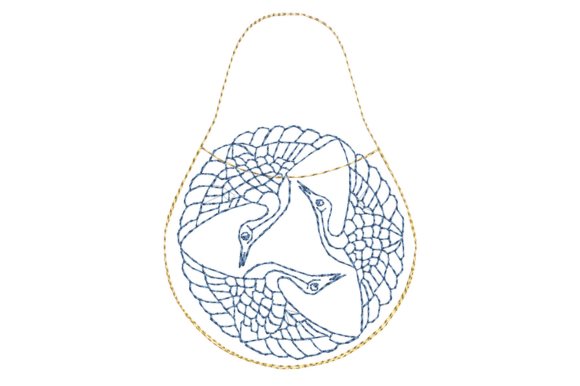
Sashiko Round Coin Pouch
A Quietly Confident Design That Earns Its Place
First impression? The Sashiko Round Coin Pouch doesn’t shout—it settles in. It carries the calm authority of traditional sashiko: clean geometry, intentional spacing, and a rhythm that feels hand-guided, not machine-perfect. The round shape isn’t just functional; it’s a visual pause—a centered, grounded motif that reads as both heirloom and contemporary. As a designer who’s stitched hundreds of client projects—from baby onesies to boutique aprons—I immediately saw how this design would behave on real fabric: no frantic detail overload, no fragile linework, no awkward scaling issues. It breathes.
Where It Lives Best (and Why Clients Notice)
This isn’t a “filler” embroidery file. It shines where intentionality matters: custom embroidered tote bags for local makers, minimalist sweatshirt pockets for small-batch apparel brands, or delicate pillow covers for nursery decor. I recently tested it on a linen-cotton tea towel for a craft fair booth—and customers paused mid-aisle. Not because it was flashy, but because it felt *considered*. That quiet confidence translates directly into perceived value. When you stitch the Sashiko Round Coin Pouch onto a handmade apron for a kitchenware shop, it doesn’t look like an afterthought. It looks like part of the brand story.
It works especially well for personalized gifts—think monogrammed coin pouches tucked inside holiday gift sets—or as a subtle embroidered patch sewn onto the chest of a child’s organic cotton jacket. For Etsy sellers, it’s a strong candidate for digital embroidery file listings paired with printable mockups: its balanced composition holds up across light and dark fabric previews without needing heavy editing.
Real Fabric Realities: What You’ll Actually Encounter
On medium-weight woven fabrics like quilting cotton or canvas? Excellent clarity. The running stitch outlines stay crisp, the fill areas read as solid but not dense, and the circular symmetry holds up even at 3.5"–4" diameter. On stretchy knits—say, a lightweight sweatshirt—you’ll want light cutaway stabilizer underneath and possibly a slight reduction in size (to ~3.25") to prevent distortion around the curve. On textured fabrics like burlap or heavy linen, the design’s open structure actually helps—it doesn’t fight the grain; it complements it.
That said, avoid pushing it too small. Below 2.75", the inner geometric motifs start to blur, especially if your machine runs slightly heavy tension or your thread is matte cotton. And on very dark fabric, test your thread colors carefully: a soft ecru satin stitch can disappear unless contrast is deliberate. For baby embroidery or items meant for frequent washing, confirm stitch density isn’t so tight that it compromises fabric drape or durability over time.
Use With Care On These Surfaces
- Curved surfaces like caps or curved tote handles—test placement first; the round shape can warp visually if hooped poorly
- Thin, slippery fabrics like rayon challis—requires tear-away + topping combo to prevent puckering
- Densely layered garments (e.g., quilted jackets)—verify hoop clearance and consider simplifying fill areas
- Products with high friction (like backpack zippers or pocket flaps)—reinforce stitching ends if using as an applique design
How It Shapes Perception—Beyond the Stitch
Stitching the Sashiko Round Coin Pouch does more than decorate—it signals care. Customers recognize craftsmanship when they see consistent spacing, intentional negative space, and a motif that feels rooted rather than trend-chasing. That builds trust, especially for small shop owners selling handmade product online. A boutique listing with this design on a ceramic mug sleeve or leather cardholder feels cohesive, professional, and gift-ready—not generic.
For commercial embroidery, it scales cleanly across formats: as a standalone machine embroidery design on a tea towel, as part of a coordinated set (e.g., matching coin pouch + key fob + notebook cover), or even adapted into a simplified line-art version for iron-on transfers. Its visual personality stays intact—no identity crisis when resized or recolored.
Practical Designer Notes Before You Stitch
- Always test on scrap fabric—especially if pairing with a new stabilizer or thread brand
- Check thread color contrast on both light and dark backgrounds before final hooping
- Review stitch density: if your machine struggles with dense fills, consider reducing fill % by 5–10% for better flow on lightweight fabrics
- Confirm hoop size compatibility—this design fits comfortably in a 4x4 hoop, but verify clearance if using specialty hoops
- Inspect small details at actual stitch-out size: those inner cross motifs should read clearly, not merge
- Test in black-and-white mockups—this design relies on shape and rhythm, not color, so grayscale preview tells you if it’ll hold up in listings
- Use proper stabilizer: medium-weight cutaway for stable wovens, tear-away + topping for knits or sheers
- Verify licensing terms before selling finished products or digital embroidery files—if unclear, contact the source directly
Final Thought: A Design That Supports Your Work, Not Competes With It
The Sashiko Round Coin Pouch doesn’t demand attention—it earns it. As a sewing and embroidery professional, I appreciate designs that serve the project, not the portfolio. This one enhances tote bag design without overwhelming it, adds quiet luxury to baby embroidery without looking fussy, and gives Etsy sellers a versatile, brand-flexible asset. It’s not “cute.” It’s considered. Not trendy. Time-aware. And in a market full of loud, fast, disposable embroidery files, that kind of restraint is rare—and commercially valuable.